A Marriage Enrichment Handbook
DOES YOUR MARRIAGE NEED A TUNE-UP?
That may sound like a crazy question, or just another thing to put on the to-do list. But whether you are newly married or have celebrated many anniversaries, MARRIAGE TAKES WORK!
LOVE IS A DECISION
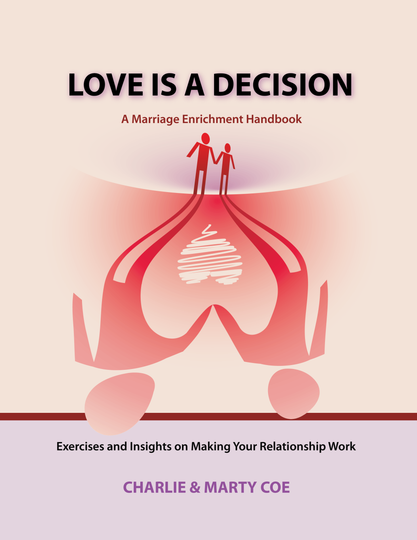
is a practical, concise, “how-to” workbook designed to help married couples grow closer to each other and to their family members. The handbook contains 136 pages with 16 chapters and 43 exercises that help couples to understand themselves better and improve their relationship. The exercises, extensively field-tested with married and engaged couples, are both enlightening and fun to complete.
That may sound like a crazy question, or just another thing to put on the to-do list. But whether you are newly married or have celebrated many anniversaries, MARRIAGE TAKES WORK!
LOVE IS A DECISION
is a practical, concise, “how-to” workbook designed to help married couples grow closer to each other and to their family members. The handbook contains 136 pages with 16 chapters and 43 exercises that help couples to understand themselves better and improve their relationship. The exercises, extensively field-tested with married and engaged couples, are both enlightening and fun to complete.
"I DON'T EVEN HAVE TIME TO GET MY CAR TUNED-UP!"
Granted, we all have a lot to do. But LOVE IS A DECISION takes a complex task and breaks it into three sections: Working on Me, Working on Us, and Working on our Spiritual Lives. Each exercise only takes a few minutes. And you can start and stop at any time.
"BUT MY MARRIAGE IS FINE."
That's great -- let's keep it that way! Do you know your spouse's love language? Learn to identify and appreciate each other's intelligences. When you spouse is down, should you give them a hug, or take on some of their workload? Taking a few minutes to really learn about your spouse's personality style and communication style can make all the difference in your enjoyment of each other.
"OUR KIDS TAKE UP ALL OF OUR FREE TIME."
The best thing you can provide your children is happy parents. A couple on the same page provides a strong foundation for children to thrive. LOVE IS A DECISION will help you figure out what "time-bandits" are stealing your time, and how to reclaim that time for you as a couple and as a family.
"WE'RE NOT THAT KIND OF PEOPLE."
We are all some kind of people. Learn the virtues and challenges that make you who you are, and everyone else who they are. All kinds of people benefit from listening with their head and their heart.
HERE'S THE BOTTOM LINE:
YOUR MARRIAGE IS WORTH IT!
ABOUT THE BOOK
LOVE IS A DECISION
is a practical, concise, “how-to” workbook designed to help married couples grow closer to each other and to their family members. The handbook contains 136 pages with 16 chapters and 43 exercises that help couples to understand themselves better and improve their relationship. The exercises, extensively field-tested with married and engaged couples, are both enlightening and fun to complete.
The book is broken up into three sections:
- Working on Me
- Working on Us
- Working on our Spiritual Lives
The enrichment handbook helps you:
- Distinguish between your ideals versus your values
- Understand and appreciate each other’s personality style
- Use Myers-Briggs as a helpful tool in your marriage and family life
- Learn the virtues and the challenges of each of your enneagram types
- Identify and appreciate each other’s intelligences
- Learn the difference between masculine and feminine characteristics
- Evaluate how you spend your time and how your relationship is affected
- Arresting the “time bandits” that steal our couple time
- Following the seven cardinal rules for family screen usage
- Speak each other’s love language
- Recognize and avoid harmful Drama Triangle situations
- Learn the difference between a thought and a feeling and how to express them
- Listen with your head and your heart
- Manage conflict effectively
- Learn how to ask for forgiveness, not just say you are sorry
FROM THE INTRODUCTION...
Happily married couples enrich and inspire us. Whether married five days or 50 years, we sense when couples are in love: their knowing glances, tender touches, gentle kidding and savored memories are telltale signs of the committed couple. Loving couples have that unmistakable aura of mutual trust and joy. Alternatively, unhappily married couples advertise themselves by their sniping, coldness, long silences, sarcasm and apathy. Their sadness, frustration, hopelessness and despair are like anchors weighing them, and all around them, down. Sadly, about one-half of all marriages end in divorce. We believe that falling in love is grace-filled—that we do not fall in love entirely by ourselves. Though we have free will, God has a hand in matching us, which makes marriage failures doubly tragic. Surely, most couples think that their marriage will work. What goes wrong?
This book’s goals are to deepen individual and mutual self-understanding and to improve communication skills. Effective communication is an acquired skill that requires sustained, hard work. A prerequisite to communicating well is self-understanding. Accordingly, the book first discusses ways to know one’s self better, then ways to communicate better. The chapters include exercises to help learn and apply the concepts and techniques. The exercises are meant to be completed independently, and then shared and discussed. In many cases we take the exercises ourselves and share our results with you. Completing the exercises will require time and effort, but we guarantee that your hard work will be worthwhile.
About the Authors
We are Charlie and Marty Coe. Married since 1967, we have lived both ends of the happiness/disillusionment continuum. In the early years, we were madly in love. We would pinch ourselves in disbelief that we were so fortunate to be married. But disillusionment insidiously crept into our marriage. We entered a life of married singles. Charlie immersed himself in his job, jogging, bowling and other activities, leaving little time for Marty. Likewise, to fill her loneliness void, Marty threw herself into to being a good mother, housekeeper, church stalwart and volunteer for a host of worthwhile causes. To the outside world, we may have looked happily married, but we knew better. We were a trainwreck waiting to happen. Growing more cold and distant, we became business partners, not lovers and best friends. While we had not mentioned divorce, the possibility loomed.
Thankfully, God and good friends intervened. In 1980 we experienced a Marriage Encounter Weekend. On Saturday night we began the process of healing past hurts and falling back in love. Throughout the weekend we learned to communicate better. We learned that love is much more than just a feeling; it is the host of decisions and kind acts we make daily to put our spouse first. On that 1980 weekend we got the first hint that God counts on each married couple, as He counts on each human being, to reflect His love for us. Accordingly, we began to reorder our priorities to make our marriage the first priority in our lives.
After over 35 years working as volunteers with engaged couples, happily married couples in the Marriage Encounter Program, and deeply disillusioned couples in the Retrouvaille Program, we believe that a good marriage rests on three bases: (1) having God as the cornerstone, (2) communicating effectively, and (3) having the engaged support of friends and family with whom we can share our deepest joys and fears.
Contact Us
We welcome any comments, questions or suggestions on the contents of the book. Please use the form below to contact the authors. Also, if you have questions about orders, you may contact the publisher at the address and phone below.
Address
White Oak Communications, LLC
6713 Candlewood Drive
Raleigh, NC 27612
Phone
919-676-5707
Contact Us
A Marriage Enrichment Handbook
ONLY $5.95
for a fixed width PDF file download.
Safe, Secure, and Instant Access

WHITE OAK COMMUNICATIONS, LLC
6713 Candlewood Drive
Raleigh, North Carolina 27612
919.676.5707